Deep Brain Stimulation for Parkinson’s Disease

Overview

What is Deep Brain Stimulation For Parkinson’s Disease?

“On-Off” Time in Parkinson’s Disease (PD)

Unfortunately, at some point along the course of the diagnosis of Parkinson’s disease (PD), the brain no longer responds consistently to the medications. The effective window (known as ON time) is shorter, and thus there is more OFF time (when the patient feels slow, sluggish, or frozen because the medications haven’t kicked in yet or have worn off too soon).

Motor Complications in Parkinson’s Disease

In addition, there are increased dyskinesias (involuntary movements), which refer to abnormal involuntary movements (not including tremor). ON/OFF fluctuations and dyskinesias are known collectively as motor complications.
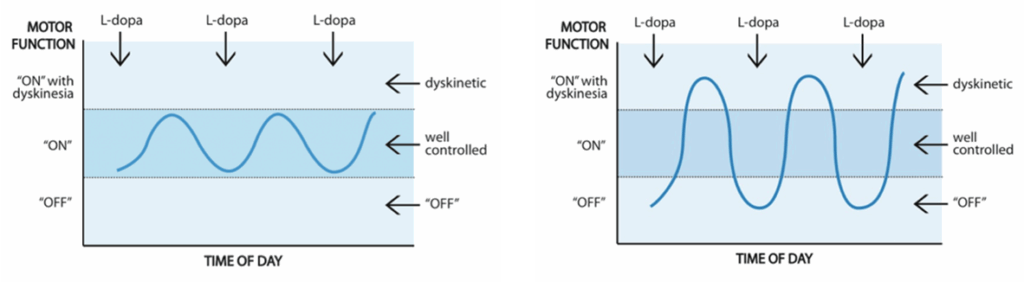
Early in the course of PD (left panel), levodopa taken 3 times per day results in relatively smooth dopamine levels with mostly ON time and few dyskinesias. Later in the course of PD (right panel), the reaction to levodopa is more erratic, with less time spent ON and more swinging between feeling OFF and feeling ON but having dyskinesias.

Whereas levodopa concentration fluctuations can contribute to unpredictable shifts between ON and OFF time, Deep Brain Stimulation remains constant through the day, meaning that there is consistent efficacy throughout the day.

Deep Brain Stimulation for Parkinson’s Disease Treatment

Patients note a significant improvement in ON time – meaning an addition of 5 good hours of productivity during the day. Deep Brain Stimulation (DBS) helps free patients from the worry of whether their medication is going to kick in at the right time for them to drive to work, participate in a meeting, have a meal, or pay a visit to a friend. This improves quality of life dramatically.

For many patients with Parkinson’s disease who continue to experience challenging symptoms, a state-of-the-art technology introduced in 2020 at Pacific Neuroscience Institute can provide comfort and relief.

The DBS surgically-implanted device called Percept™ PC Neurostimulator with BrainSense™ technology detects patient-specific brain signals and provides feedback to optimize therapy for patients with Parkinson’s disease. Benefits include improvements in tremors, rigidity, slowness of movement and overall quality of life.

Our movement disorders neurology and restorative neurosurgery specialists provide DBS expertise and experience. The first in Providence health system to use Percept™ PC with BrainSense™, this breakthrough in monitoring and treatment technology can be considered for patients who need to take their current medications too frequently, or who can no longer tolerate their current treatment regimen. This DBS system is available for new patients as well as for updating older implanted DBS systems.

Patients receive a comprehensive and personalized medical and treatment assessment to determine of DBS is an appropriate choice.

Types

Types of Deep Brain Stimulation For Parkinson’s Disease

Deep Brain Stimulation (DBS) can also significantly reduce dyskinesia. DBS for Parkinson’s disease can be done in one of two sites: globus pallidus interna (GPi) or subthalamic nucleus (STN). When DBS targets STN, patients tend to have a reduction of their levodopa dose, in turn resulting in less dyskinesias. When DBS targets GPi, patients tend to require the same dose of levodopa, but the dyskinesias are reduced significantly even without any change in the dose of levodopa. The degree of sensitivity to medication (the degree of dyskinesia at low doses) as well as other factors will determine whether our team recommends GPi or STN implantation.

Symptoms that do not respond to levodopa (such as balance problems) are unlikely to improve with Deep Brain Stimulation (DBS). Also if a patient with Parkinson’s Disease has no response (benefit) when taking adequate doses of levodopa, they are unlikely to experience any benefit from DBS. Sometimes patients would have a good response to levodopa, but they cannot tolerate the optimal dose.

This can be determined by doing a pre- and post-medication examination while the patient is in the clinic, giving a high dose of medication on an empty stomach. Patients who have good benefit to levodopa but cannot tolerate it may be good candidates for DBS. Patients should expect DBS to provide the same benefit as their best response to levodopa, but in a more consistent and reliable way. Please note that DBS is not a cure, and does not benefit imbalance, cognition, or freezing.

The only exception to the rule that DBS provides the same benefit as the best response to levodopa is tremor. Many patients with tremor-predominant PD find that while other motor symptoms (slowing, stiffness, shuffling, small handwriting) improve with medication, the tremor may not respond as much, or at all.

These patients do still enjoy significant benefit in tremor reduction with DBS, by about 75%.

Statistics

Statistics About Deep Brain Stimulation For Parkinson’s Disease

DBS Treated Worldwide

Since 1995, more than 160,000 patients with movement disorders have been treated with DBS worldwide.

FDA-Approved

DBS was FDA-approved for advanced PD in 2002.

Approved for Use in Earlier Stages of Parkinson’s Disease

In 2016, DBS was FDA-approved for use in earlier stages of PD: four years after onset and four months after the development of motor complications.

BrainSense™ Technology Launched

Medtronic’s Percept PC™ with BrainSense™ technology launched in 2020. It detects patient-specific brain signals and continuously gathers feedback to optimize therapy.

Candidates

Candidates for Deep Brain Stimulation For Parkinson’s Disease

Who is a Candidate for DBS?

  • Good initial response to levodopa
  • On-off fluctuations (at least four months)
  • Troubling dyskinesias
  • Disabling tremor
  • Absence of dementia or severe depression
  • Normal MRI for age
  • Good medical health
  • Realistic expectations
Benefits

Potential Benefits of Deep Brain Stimulation For Parkinson’s Disease

Benefits of Deep Brain Stimulation for Parkinson’s Disease:

  • Improved “on-time” (gain of 5 hours/day on average)
  • Reduced tremor (75% improved on average)
  • Improved quality of life
  • Reduced need for medication (25% reduction on average)
Risks

Potential Risks of Deep Brain Stimulation For Parkinson’s Disease

Risks and Side Effects of Deep Brain Stimulation Surgery:

  • Post-operative headache and pain are possible but typically resolve gradually a few weeks after the procedure.
  • Neck pain is also possible in the short term. Infection of the leads, extension or battery is very low risk and our surgical team does their utmost to prevent this.
  • Hemorrhage is extremely low risk but when it occurs may lead to stroke-like symptoms. Most frequently, hemorrhage does not result in permanent complications.
  • Lead fracture or migration, also very low risk, may require repeat surgery.
  • Problems with speech, language and mood; muscle tightness, slurred speech and vision symptoms can be related to the stimulation and thus can usually be reduced or eliminated by adjusting the stimulation.
Team

Deep Brain Stimulation For Parkinson’s Disease Specialist
Resources

Learn More About Deep Brain Stimulation For Parkinson’s Disease

FAQs

The incisions are small, about 2 inches on the top of the head, 1 inch behind the ear, and 2.5 inches below the collarbone. Typically only a small area near the incision on the top of the head requires shaving.

3-4 years depending on the settings required. A rechargeable option is also available which will last 9 years, but requires the patient to regularly charge the battery.

Once the electrodes are placed, a neurological exam is done to ensure that therapeutic benefit has been achieved. During this examination, the patient is awake. During the procedure, the anesthesia is tailored to the patient’s needs to make sure that pain and anxiety are properly relieved.

Patients typically go home after 1 or 2 days. Most patients feel they are back to their baseline level of energy after 2 weeks. The sutures are removed one week after surgery and DBS programming can be done at this visit. We recommend avoiding strenuous activity for the first month post-operatively. It can take several weeks, up to a couple months, to find the optimal settings for DBS programming and adjust medications.

Patients are given a patient controller which allows them to turn the DBS on and off (typically it’s left on the entire time); and depending on the patient we may allow for adjustment of one parameter of programming to a certain degree. Initial programming and major readjustments are done by our expert team.

After the recovery period, it is fine to fly. We will provide paperwork so the TSA is aware that you have a medical device and it is preferable to avoid going through airport scanners. However, there is only a very low risk of scanners turning off the device. When flying, patients should take their patient controller device with them to be able to verify whether the DBS is on or off.

MRIs, of the head or the body, may be considered if medically necessary, but the type of MRI machine may be restricted to a lower magnetic field (1.5 T), and certain types of MRI may require special equipment. Always tell the radiology technician of any implanted devices. Typically, the DBS is turned off during the MRI and turned on afterwards. We work closely with you to coordinate pre- and post-MRI management.

Yes. Medicare and most private insurances cover DBS because it is standard therapy for PD, ET and dystonia. DBS is FDA approved for PD. Our office would obtain prior approval from your insurance company.

Five-year and ten-year follow-up studies show sustained improvement in symptoms of PD, ET and dystonia over time. However, DBS is not a cure of PD, which typically continues to progress.

In the first few weeks, weekly visits are typical to fine-tune the adjustment of the DBS. Following that, visits are scheduled on an as-needed basis. At minimum, DBS patients follow up every 6 months to verify the battery level and ensure stability of treatment.

The leads and battery are all internalized, but in a slender person, there may be a slight bump visible under the skin of the neck and upper chest below the collarbone. In a person whose hairline is receding, the scalp incision scar may be visible and there may be two small bumps, about the size of a quarter, which can be felt or sometimes seen. The battery looks and feels very similar to a pacemaker battery.

Be sure to tell all providers that you have a DBS system in place. Of course, your referring physician and primary care physician will receive notes from our clinic. Dental care can be undertaken but with various precautions, such as avoiding dental drills and ultrasonic probes over the implant site and using antibiotics prior to invasive procedures such as root canals and implants.

Let your surgeon and the DBS team know prior to surgery. The DBS system should be turned off for the procedure or for CT scans. Electrocautery, electrolysis and radiation therapy should not be used over the implant site. There is no problem with X-ray or ultrasound.

The decision regarding driving is complex and should be determined by your providers who are well familiar with your case. In some cases, patients can resume driving as soon as they are no longer using sedating pain medications. In other cases, drivers’ evaluation testing may be advised to ensure that the reaction timing is intact.

No. Deep-heat treatments, also known as diathermy, deliver energy to treat specific parts of the body, and can result in severe injury or death in patients who have DBS in place. This includes microwave diathermy, ultrasound therapeutic diathermy and shortwave diathermy.

No.

Yes, but tell your doctor so they are aware of the DBS to avoid interference with the system.

Limited exposure (10-15 minutes) to heat equal or less than 100 degrees Fahrenheit should not cause any trouble, but hot tubs and tanning beds often result in heat exposure above the acceptable range, and therefore are best avoided.

Most household appliances will not harm the DBS, including radios, microwaves, computers. Older generation DBS systems were susceptible to accidentally being turned off or on by nearby magnets including those on refrigerators, but does not to occur with newer generation DBS. Still, you should always carry your patient programmer so you can check your system if you are not sure if it is on or off.

You can be around industrial equipment and use power tools but always carry your patient programmer so you can check to make sure your system is working properly after use. You should not arc weld.

Ask your DBS team prior to scuba diving. The device should function normally down to 33 feet of seawater. Skydiving should be avoiding because of the dramatic forces put on the head and neck which can damage the leads and connections of the DBS system.

Resources

Next Steps

Get Expert Care from Leading Specialists

Contact Us

Our movement disorders neurology and restorative neurosurgery team can be reached at 310-582-7433.

Written and reviewed by:
The Pacific Neuroscience medical and editorial team
We are a highly specialized team of medical professionals with extensive neurological and cranial disorder knowledge, expertise and writing experience.

Last Updated: