Duopa

Overview

What is Duopa?

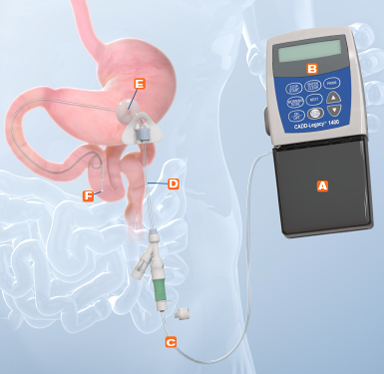
Duopa is an intestinal gel that provides continuous levodopa, and improved function, in patients with Parkinson’s disease (PD).

In patients with advanced PD, fluctuations in levodopa levels when taken orally are associated with variability in functioning. When the medication has worn off, or before it kicks in, patients feel slow, stiff, sluggish. This is known as “off” time. When the medication has kicked in, patients feel their movements are smoother, faster, and closer to their usual self. This is known as “on” time. Excessive levodopa levels result in abnormal involuntary movements (not counting tremor), known as dyskinesias. Patients with advanced PD swing widely and unpredictably from being “off” to “on” with dyskinesias without enough time spent in the “on” without dyskinesias state.
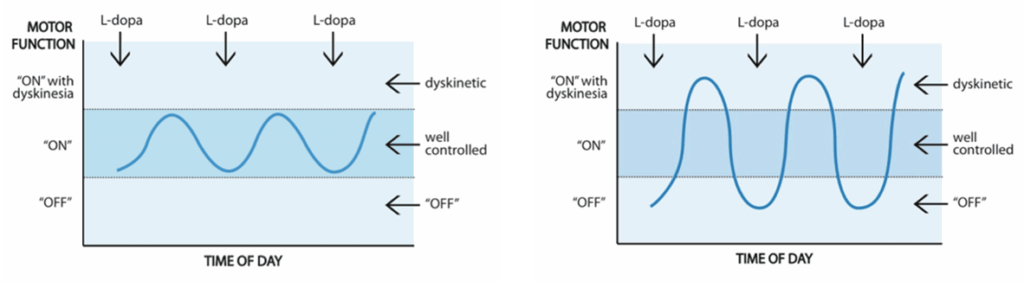
Early in the course of PD (left panel), levodopa taken 3 times per day results in relatively smooth dopamine levels with mostly ON time and few dyskinesias. Later in the course of PD (right panel), the reaction to levodopa is more erratic, with less time spent ON and more swinging between feeling OFF and feeling ON but having dyskinesias.
How it Works

How Duopa Works

The intestinal gel formulation of levodopa, Duopa, is infused directly into the small intestine via a feeding tube. The feeding is placed by our gastrointestinal specialists and our movement disorders clinicians would assist in the management of the medication. Detailed in-home training is given by a skilled nurse to the patient and/or their caregiver to understand how to administer the medication. Duopa is given via cartridge, lasting 16 hours per day for continuous absorption. Duopa reduces the “off” time by 2 hours and improves “on” time without dyskinesias by about 2 hours compared to immediate-release carbidopa/levodopa.

Who would benefit

Who Would Benefit From Duopa

Duopa therapy can be a good option for patients with advanced Parkinson’s disease who are experiencing significant on/off motor fluctuations despite oral medications. It may be especially beneficial for individuals who are not candidates for brain surgery, such as deep brain stimulation (DBS), due to dementia, psychological concerns, or personal preference.

When to Avoid

When to Avoid Duopa

Duopa is not suitable for everyone. It should be avoided in patients with abdominal conditions such as intestinal obstruction, stomach or abdominal wall disease, or serious bleeding disorders. Potential gastrointestinal complications from feeding tube placement include infection, bleeding, ulcer formation, bowel obstruction, or tube displacement, which may require further procedures or surgery.

In addition, generalized polyneuropathy (nerve damage) has been associated with Duopa use and may present as numbness, tingling, or weakness in the hands or feet. Careful evaluation by a movement disorder specialist is necessary to determine whether Duopa is the right treatment option.

Resources

Resources for Duopa Treatment

Next Steps

Get Expert Care from Leading Specialists